
November 2026 Core Update: A Practical SEO Action Plan for Website Owners
- Home
- November 2026 Core Update: A Practical SEO Action Plan for Website Owners
Published: November 16, 2026
Last Updated: November 16, 2026
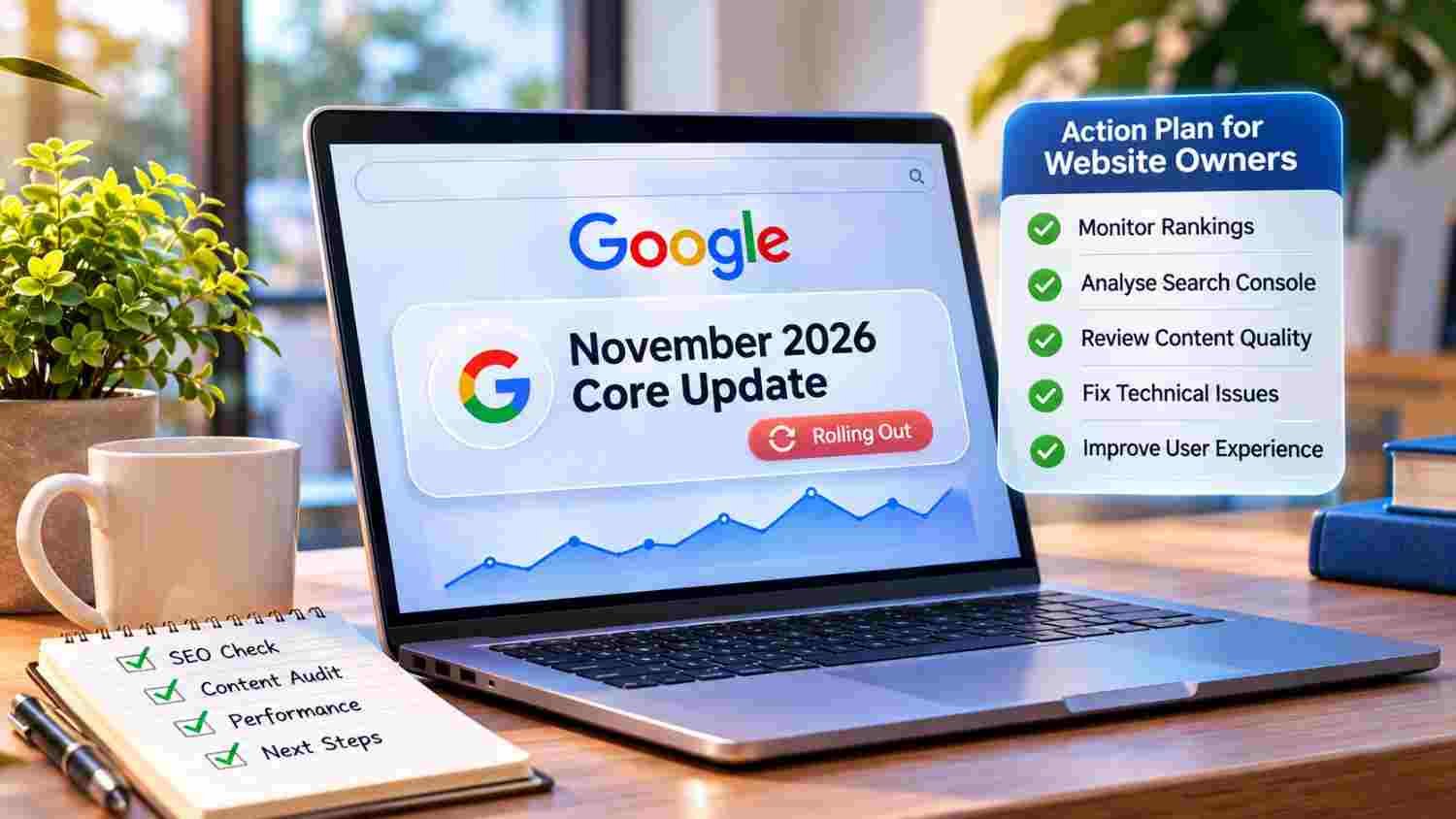
The November 2026 Core Update is Google's latest broad search ranking update, which began rolling out on November 10, 2026. It applies globally and to all languages, and Google has stated that the rollout may take up to two weeks.
If your website experiences ranking fluctuations, do not immediately rewrite pages or make major SEO changes. First, monitor the official update status, record your Search Console performance, and identify which pages and search queries are affected. After the rollout finishes, wait at least one full week before making a detailed comparison. Then investigate content quality, search intent, technical issues, and changes in user demand.
Website owners should monitor the November 2026 Core Update without making rushed changes. Google recommends confirming that the rollout has finished before analysing its impact, then comparing Search Console performance across appropriate periods. If a website experiences a significant and sustained decline, review the affected pages, assess their usefulness, check technical and security issues, and improve content where meaningful changes are needed.
Google started the November 2026 Core Update on November 10.
The update applies globally and to all languages.
Google says the rollout may take up to two weeks.
Ranking fluctuations during an active rollout do not automatically indicate a website penalty.
Use Google Search Console to investigate changes in clicks, impressions, CTR, and average position.
Wait at least one full week after the rollout completes before conducting Google's recommended comparison.
Improve content for users instead of making changes just to influence rankings.
This guide is for website owners, SEO executives, digital marketing professionals, bloggers, e-commerce businesses, and website managers in India. It is especially useful for people monitoring organic traffic, managing Google rankings, or investigating changes in search visibility during an algorithm update.
For example, a Dehradun-based service business may notice fewer website enquiries, while an e-commerce store may see changes in impressions for important product pages. Both should investigate the data before assuming that the update caused the decline.
Google periodically makes broad improvements to its search ranking systems. These changes are known as core updates.
Unlike an update aimed at a particular website feature or a specific spam practice, a core update is designed to improve how Google evaluates and presents search results overall.
Google explains that core updates do not target individual websites or pages. Instead, its systems reassess content across the web to identify results that better satisfy searchers.
According to the official Google Search Status Dashboard, the November 2026 Core Update started on November 10 at 10:06 a.m. US Pacific Time. The announcement states that it applies globally and to all languages, with the rollout potentially taking up to two weeks.
As of November 16, the dashboard still lists the update as active.
This means website owners should distinguish between temporary ranking movement during the rollout and longer-term performance changes that remain after it finishes.
A broad core update can change the positions of individual pages and websites in Google Search.
Some pages may gain visibility, while others may lose positions. Additionally, the movement does not necessarily mean that a page contains an error or violates Google's policies.
For example, imagine two articles targeting the same search query. Both may contain accurate information, but one provides clearer explanations, more useful examples, and a better overall experience. Google's systems may reassess which result is more helpful.
The following changes may be visible during a core update:
These are possible patterns, not confirmed descriptions of what the November update specifically targets. Google has not published a detailed list of individual ranking changes for this update.
A decrease in organic traffic does not automatically mean that your website has been negatively affected by a core update.
Google recommends investigating several possible causes.
Check whether a confirmed Google ranking update overlaps with the dates when your traffic changed.
However, timing alone does not establish that the update caused the decline.
Some products and services experience changes in demand throughout the year. For instance, educational course searches, holiday-related products, and seasonal services may naturally receive different traffic at different times.
Use Google Trends to investigate whether search interest has changed.
Check for indexing problems, server downtime, robots.txt issues, incorrect noindex directives, or other crawling and serving errors.
Recent URL changes, website migrations, navigation updates, and content removals can affect organic visibility.
Review your deployment history alongside Search Console data.
If impressions remain relatively stable but clicks decline, investigate your title tags, descriptions, rich results, and the way your pages appear in search results.
For additional guidance, consult Google's official guide to investigating Search traffic drops.
A structured approach is more useful than reacting to every daily ranking movement.
Start with the Search Status Dashboard. Confirm the update's start date, current status, and completion date when Google publishes it.
Avoid interpreting performance changes as final while the rollout is active.
Open Google Search Console and review the Performance report.
Record the following metrics:
Total clicks.
Total impressions.
Average click-through rate.
Average position.
Top-performing queries.
Pages receiving the most organic traffic.
Keep a record of important website changes and publishing dates as well. This information can help you investigate possible causes later.
Once the rollout is complete, use an appropriate comparison period.
Google recommends waiting at least one full week after the update finishes before analysing your website. Then compare the week after completion with the week before the rollout started.
Review your highest-traffic pages and queries. Look for patterns rather than treating every small position change as a problem.
A small ranking movement may not require any action.
For example, a page moving from position 3 to position 5 does not automatically justify rewriting the article.
However, a sustained decline across many important queries and pages deserves a deeper investigation.
Review the pages experiencing the largest changes.
Ask whether each page answers the intended search query, provides accurate information, includes useful examples, and offers something valuable beyond a basic summary of other websites.
Where improvements are genuinely needed, update the content carefully.
Google encourages website owners to prioritise helpful, reliable, people-first content instead of making short-term changes designed only to influence rankings.
Consider these improvement areas:
Each article should answer the reader's actual question and provide sufficient information to help them complete their task.
Add original explanations, practical examples, verified facts, relevant comparisons, and useful insights.
Avoid publishing multiple pages that repeat almost identical information with slightly different keywords.
Check whether your page matches what users actually expect from a search query.
Someone searching for a step-by-step guide may need practical instructions, while someone comparing software may need features, limitations, and a comparison table.
Verify statistics, product details, regulatory references, and claims using reliable sources.
Include accurate author information and explain relevant experience where appropriate. Make sure contact information and company details are easy to find.
Review mobile usability, navigation, page loading, readability, and intrusive elements.
A visitor should be able to access the main information without unnecessary difficulty.
Do not change publication dates or rewrite an article simply to make it look fresh.
Improve outdated information, correct factual mistakes, and add genuinely useful material when needed.
Google's helpful, reliable, people-first content guidance provides a useful checklist for this process.
During an active Google update, avoid these common mistakes:
Rewriting every article because of one day's ranking movement.
Deleting useful pages without examining their purpose and performance.
Changing keywords repeatedly without understanding search intent.
Publishing large volumes of low-value content to compensate for traffic declines.
Buying backlinks or using manipulative link-building techniques.
Treating every ranking fluctuation as a Google penalty.
Changing publication dates without making substantial content improvements.
Instead, focus on evidence from Search Console, confirmed technical issues, and meaningful improvements to the pages that genuinely need attention.
Managing organic search visibility requires regular performance monitoring, technical analysis, useful content, and a clear optimization strategy.
Tulyarth DigiWeb provides SEO and digital marketing services to help businesses improve their online presence. Businesses can explore its digital marketing services in Dehradun to understand the available services.
For more guidance on technical search issues, you may also find our guide to why websites are not indexed by Google useful.
You can also learn about Tulyarth DigiWeb before evaluating your digital marketing requirements.
When you are ready to discuss your SEO goals, contact Tulyarth DigiWeb about your website's search visibility.
The November 2026 Core Update is a broad Google ranking update that began on November 10 and is still listed as active on November 16. Since the rollout may take up to two weeks, website owners should avoid making rushed decisions based on incomplete ranking data.
Monitor the official update status, record Search Console performance, and investigate significant changes after the rollout finishes. If your website experiences a sustained decline, review affected pages, search intent, technical health, and content quality.
Most importantly, focus on creating useful and reliable pages that genuinely help visitors. Sustainable SEO improvements are more valuable than chasing short-term ranking changes.
You may also find these articles helpful:
Google Business Profile Optimization: How to Get More Local Calls & Enquiries (2026)
WhatsApp Business AI in India: How Small Businesses Can Use It (2026 Guide)
Google Ads Quality Score: What It Means and How to Improve It (2026)
Google Ads Conversion Tracking: How to Track Leads, Calls and Sales
Google Ads vs Meta Ads: Which Is Better for Lead Generation in India?