Google Ads vs Meta Ads: Which Is Better for Lead Generation in India?
- Home
- Google Ads vs Meta Ads: Which Is Better for Lead Generation in India?

Published: October 17, 2026
Last Updated: October 17, 2026
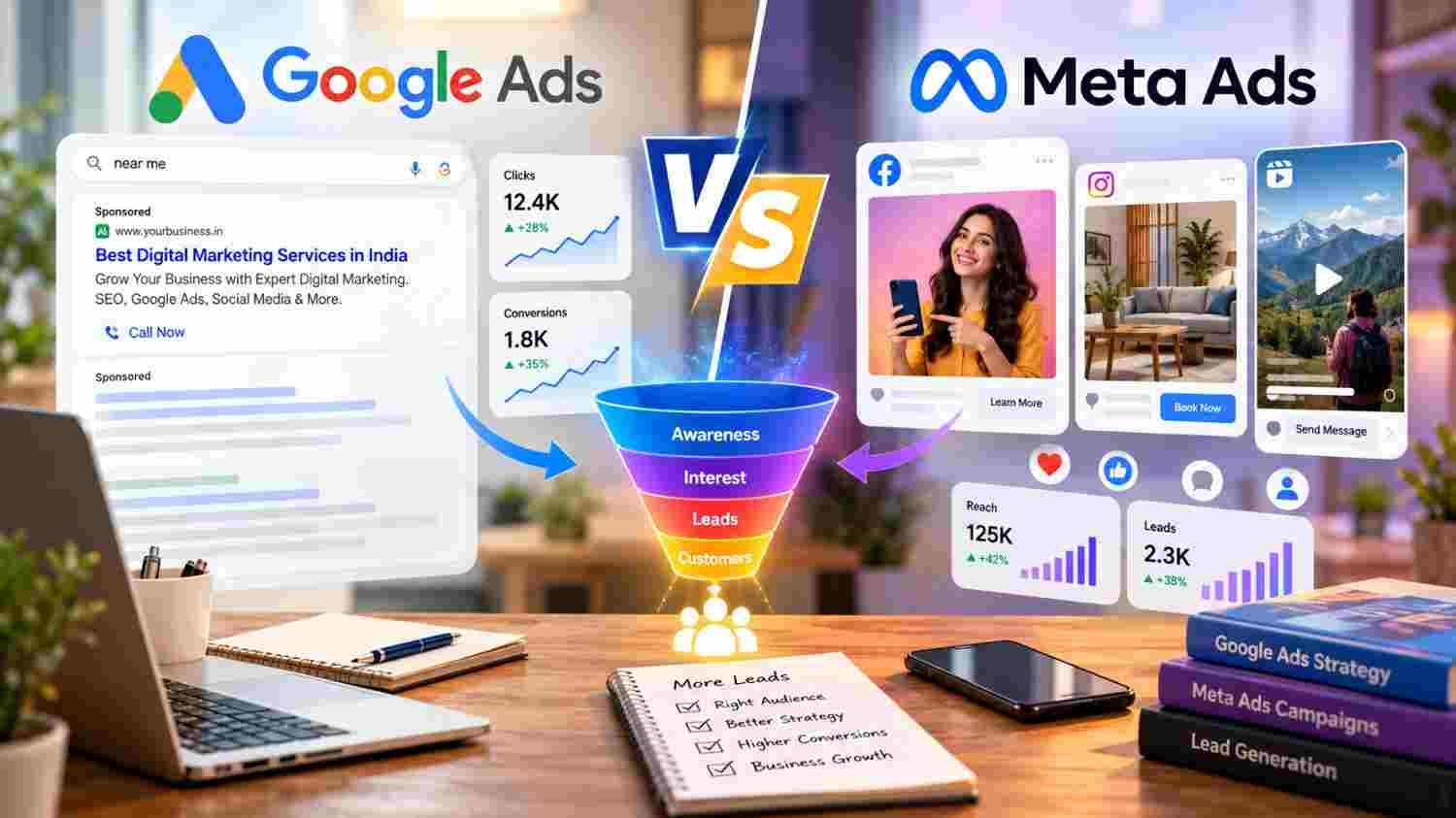
Google Ads vs Meta Ads is not a question of which platform is always better. Google Ads can help businesses reach people actively searching for their products or services, while Meta Ads can introduce offers to relevant audiences through platforms such as Facebook and Instagram.
For example, a person searching for a nearby dentist may be ready to book an appointment, making Google Search Ads worth testing. In contrast, a clothing brand launching a new collection may benefit from visual Meta Ads that introduce products to potential customers.
The right choice depends on your audience, industry, campaign objective, website experience, and ability to follow up with leads. Some businesses can also use both platforms together.
Google Ads is often a strong starting point when customers actively search for a solution. Meta Ads can help when a business needs to build awareness, showcase a product, or reach relevant people who haven't started searching yet. Neither platform guarantees qualified leads or sales. Businesses should compare campaign results using conversion tracking, lead quality, and actual sales outcomes.
Google Ads can capture existing demand from people searching for specific products or services.
Meta Ads can build interest through visual content, audience targeting, and social media placements.
Lead quality depends on the offer, targeting, landing page, and follow-up process.
Small businesses should test the platform that best matches their customers' behaviour before expanding.
Combining Google Ads and Meta Ads can support different stages of the customer journey.
Google Ads is an advertising platform that allows businesses to promote products and services across eligible Google advertising channels. Search campaigns can connect relevant ads with people searching for specific terms. Advertisers can choose relevant keywords and review search-term insights to understand what customers are looking for.
Read Google's official guide to keywords in Search Network campaigns for more information.
Meta Ads allows businesses to advertise across eligible placements on platforms such as Facebook and Instagram. Depending on the campaign objective, businesses can use images, videos, Reels, lead forms, and other ad formats to reach suitable audiences.
In simple terms, Google Search often helps businesses reach existing demand, while Meta Ads can build awareness and interest. However, these roles can overlap depending on the campaign type and audience.
This comparison describes common use cases, not fixed rules. Performance varies by industry, audience, targeting, competition, offer, and campaign setup.
Google Ads can be a practical option when potential customers already know what they need and use Google to find a solution.
Consider a business that provides accounting, plumbing, web development, or dental services. Potential customers may search for a provider, compare alternatives, and contact a business that appears relevant.
A well-targeted Search campaign can help the business compete for these searches. Nevertheless, an ad appearing for a relevant query does not automatically mean the visitor will become a customer.
Google Ads may suit businesses whose services are easy to describe through search terms.
For example, a user searching for “website development company in Dehradun” has expressed a clearer need than someone casually browsing business content. A relevant ad and landing page can help that user understand the service and take the next step.
A click is useful only when it contributes to a business objective. Therefore, track actions such as qualified form submissions, phone calls, appointments, and completed purchases where appropriate.
Google explains how advertisers can measure meaningful actions in its official guide to conversion tracking.
Before launching a campaign, make sure the chosen conversion actions are configured correctly. Otherwise, you may struggle to distinguish genuine business results from ordinary website traffic.
Meta Ads can be suitable when businesses need to introduce an offer, build interest, or reach people based on audience and campaign signals rather than relying exclusively on active search demand.
Fashion brands, restaurants, salons, fitness centres, home decor businesses, and educational institutions may have offers that are easier to communicate through strong visuals.
For instance, a clothing business can use a short video to demonstrate a new collection. A coaching institute can highlight course features, student support, and upcoming admissions.
The creative should communicate a clear benefit and give the audience a suitable next step.
Meta offers a Leads campaign objective, with available configurations depending on the account and placement. Businesses can use eligible lead-generation formats to collect enquiries from interested people.
However, generating a large number of form submissions is not the same as generating qualified prospects. Ask only for the information you need, explain the next step clearly, and contact genuine enquiries promptly.
Review Meta's official business guidance on creating video ads for campaign setup information.
When a product or service is new, potential customers may not know the right search terms or even realise that the solution exists. In such cases, relevant Meta creative can help introduce the offer.
Even so, audience relevance matters more than broad reach alone. Test different messages and evaluate the enquiries they produce rather than judging a campaign only by views, likes, or impressions.
The following examples are starting points for testing, not guarantees of performance.
For businesses in Dehradun or elsewhere in India, local targeting can be important. However, location alone will not guarantee relevant leads. The offer, audience, search terms, creative, landing page, and follow-up process must work together.
Before choosing between Google Ads and Meta Ads, follow these practical steps.
First, investigate whether people search for your product or service directly. If they do, Google Search may be a sensible starting point. If they are more likely to discover your offer through videos, images, recommendations, or social content, Meta may deserve an early test.
Next, decide whether your priority is qualified enquiries, appointments, online sales, or brand awareness. Different objectives require different campaign setups and measurement methods.
For example, a lead-generation campaign should be evaluated on the quality of enquiries and their progression through the sales process, rather than clicks alone.
Your ad and destination should communicate the same offer. A confusing landing page, slow mobile experience, unclear service details, or unnecessarily complicated form can discourage potential customers.
Therefore, make the next action obvious. Explain what the business provides, who it serves, and how an interested person can enquire.
Record how many leads are valid, how many match your target audience, how many receive a response, and how many become customers.
Additionally, use appropriate conversion tracking and consistent reporting. Google Ads provides guidance on choosing what to measure based on advertising goals.
Start with a focused campaign that matches your current objective. Review search terms or creative performance, remove irrelevant targeting where appropriate, and improve the elements that prevent relevant prospects from converting.
Give the campaign enough relevant data to evaluate performance, while monitoring spend and lead quality. Do not continue an ineffective campaign simply because it has generated many clicks or form submissions.
Yes. Businesses can use both platforms when they serve distinct purposes, and the business can manage the campaigns effectively.
For example, a web development company could use Google Search Ads to reach people looking for website development services. It could also test Meta Ads to introduce its services to relevant business audiences and reconnect with eligible previous website visitors, subject to platform requirements and applicable privacy rules.
A combined approach can support several stages of the customer journey:
Discovery: Introduce the business and its services through relevant content or advertising.
Consideration: Help interested people understand the offer, benefits, and suitability.
Enquiry: Make it easy to request information, book a call, or complete a form.
Follow-up: Respond to enquiries, qualify prospects, and measure which campaigns contribute to sales.
However, running both platforms is not mandatory. If resources are limited, begin with the channel that best matches your audience's behaviour. Expand only when measurement, lead handling, and campaign performance justify it.
Even a well-known advertising platform can perform poorly when the campaign is planned incorrectly.
Avoid these common mistakes:
Choosing a platform only because competitors use it.
Assuming the lowest cost per lead always represents the best result.
Sending every visitor to the homepage instead of a relevant destination.
Tracking clicks while ignoring qualified enquiries and sales.
Using generic messaging that does not explain the offer.
Failing to respond to leads promptly.
Making large campaign changes without reviewing performance data.
Using customer data for remarketing without considering applicable consent and privacy requirements.
Instead, connect campaign objectives with business outcomes. This makes it easier to decide what is working and where improvements are necessary.
Selecting an advertising platform is only one part of a lead-generation plan. Businesses also need clear messaging, relevant landing pages, appropriate tracking, and a process for handling enquiries.
Tulyarth DigiWeb provides digital marketing services that include SEO, social media marketing, and Google Ads and PPC management. Businesses can explore its digital marketing services in Dehradun to understand its service offering.
Before choosing a strategy, define your target audience, primary conversion, service area, and follow-up process. You can also learn about Tulyarth DigiWeb to understand more about the company.
When you are ready to discuss your business objectives, contact Tulyarth DigiWeb about your digital marketing requirements.
Choosing between Google Ads and Meta Ads starts with understanding how your customers discover, evaluate, and buy your product or service. Google Ads can help capture existing search demand, while Meta Ads can support product discovery, audience engagement, and lead generation through social placements.
Ultimately, Google Ads vs Meta Ads should be decided by campaign objectives, lead quality, customer behaviour, and measurable business outcomes—not by assumptions that one platform always performs better.
Start with a clear goal, build a relevant destination, track meaningful conversions, and improve campaigns using evidence. When both platforms serve different purposes, a coordinated strategy may help your business reach prospects at multiple stages of their journey.
You may also find these articles helpful: