
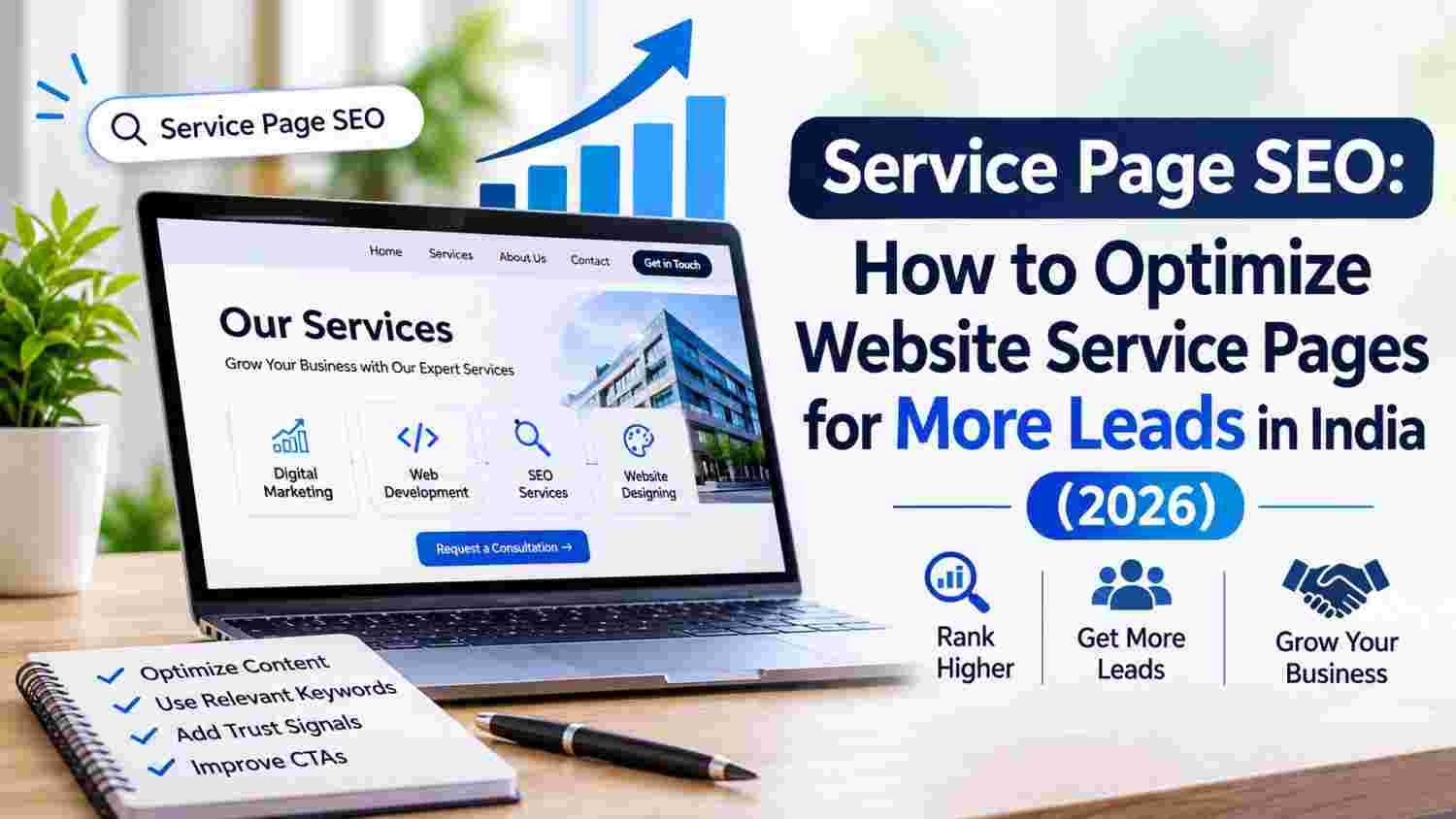
Service Page SEO: How to Optimize Website Service Pages for More Leads in India (2026)
- Home
- Service Page SEO: How to Optimize Website Service Pages for More Leads in India (2026)
Published: November 28, 2026
Last Updated: November 28, 2026
Service Page SEO is the process of optimizing individual website pages that describe a business's services so they can appear for relevant search queries and encourage visitors to enquire. It involves understanding search intent, choosing relevant keywords, writing useful service descriptions, improving page structure, adding trust signals, and making contact options easy to find.
A well-optimized service page should do two things: help search engines understand what the business offers and help potential customers decide whether the service meets their needs.
An SEO-friendly service page clearly explains one specific service, addresses the questions potential customers may have, uses relevant search terms naturally, and provides a clear next step. It should include a descriptive title, one main heading, useful content, relevant internal links, genuine business information, and an accessible contact option. Mobile usability and page performance also contribute to a better experience.
Give every important service its own focused page.
Match the content with the search intent of potential customers.
Use relevant keywords naturally in titles, headings,and descriptions.
Explain services, processes, benefits and deliverables clearly.
Add genuine testimonials, credentials and business information.
Use descriptive internal links to connect related pages.
Make enquiry options visible on desktop and mobile.
Track organic traffic, enquiries and conversion performance.
A service page is different from a general homepage or a blog post. Its main purpose is to explain a particular service and help visitors take the next step.
For example, a digital marketing agency may offer SEO, social media marketing, website development and paid advertising. Instead of describing every service in one long section, it can create separate pages for each offering.
This approach gives visitors more relevant information and helps search engines understand the purpose of individual URLs.
Before writing a page, answer these questions:
What service is being offered?
Who is the ideal customer?
What problem does the service solve?
What information does a customer need before enquiring?
What action should the visitor take?
A clear purpose gives the page a stronger direction.
Keyword research helps you understand how potential customers search for a service. However, choosing keywords only because they have high search volume can lead to irrelevant traffic.
Start by identifying the main service and the audience you want to reach.
For example, a website development company might target:
Use keyword research tools, Google autocomplete, related searches and Search Console data where available.
Also, understand the difference between informational and commercial searches. Someone searching for "what is website development" may want to learn, while someone searching for "website development company in India" may be comparing providers.
Your service page should primarily satisfy the commercial intent relevant to that service.
One common mistake is placing every service on a single page and expecting it to rank for multiple unrelated searches.
A more organized structure helps users find the exact information they need.
For example:
/web-development/
/website-designing/
/seo-services/
/social-media-marketing/
Each page should have a distinct purpose and original content.
Avoid creating multiple pages that target nearly identical keywords without offering a meaningful difference. This can create keyword overlap and make it difficult to establish which page should rank for a query.
Create separate pages when the services, audiences, search intent or information requirements are genuinely different.
The SEO title and meta description help communicate what a page is about in search results.
Your title should describe the service accurately and include the main keyword naturally.
Example SEO title:
Website Development Services in India | Custom Business Websites
Example meta description:
Explore professional website development services for your business. Get responsive, user-friendly websites designed around your goals.
Avoid repeating the same keyword unnecessarily. Each important service page should have its own unique title and description.
Google may generate title links and search snippets using different page elements, so write accurate page headings and useful introductory content as well.
Reference: Google's SEO Starter Guide.
A good heading structure makes service information easier to scan.
Use one clear H1 that explains the main service. Organize the remaining information under descriptive H2 and H3 headings.
For example, a website development service page could follow this structure:
H1: Website Development Services for Growing Businesses
H2: What Our Website Development Service Includes
H2: Types of Websites We Develop
H2: Our Website Development Process
H2: Features of Our Website Development Solutions
H2: Why Choose Our Team?
H2: Frequently Asked Questions
Do not add headings only to insert keywords. Every section should answer a real customer question or explain an important part of the service.
Visitors need useful details before contacting a business.
Statements such as "We provide the best services" or "We deliver high-quality solutions" do not explain what customers will actually receive.
Instead, describe the service in practical terms.
For example, a website development page could explain:
Website planning and requirement analysis
UI/UX design
Front-end and back-end development
Mobile responsiveness
Content management system integration
Website testing and launch
Maintenance and technical support
Only mention features that the business genuinely provides.
Where possible, explain the process, expected deliverables and how the service addresses a customer's problem. This makes the content more useful and helps visitors evaluate whether the offering is suitable.
Customers often compare multiple service providers before making a decision. Your page should make it easier for them to understand who they are dealing with.
Useful trust signals include:
Genuine customer testimonials
Relevant project examples
Team or company information
Professional certifications, where applicable
Clear business contact details
Relevant experience and expertise
Transparent descriptions of the working process
For example, a digital marketing agency can explain the types of campaigns it manages and show genuine examples of its work.
Do not publish fabricated reviews, unsupported success rates or exaggerated performance claims. Trust should come from verifiable information rather than promotional language.
Internal links connect your service page with other useful pages on your website.
They help visitors discover related information and help search engines understand how different pages are connected.
For example, a website development service page may link to:
A related website design service
An article about website development costs
A guide to website maintenance
A relevant project or portfolio page
The contact page
Use descriptive anchor text that explains the destination. Avoid using the same exact-match keyword for every link.
Internal links should be relevant to the sentence and genuinely useful to readers.
Google also recommends using descriptive link text to help users and search engines understand linked pages.
Reference: Google's SEO Starter Guide – Links.
Many potential customers browse service websites on smartphones. If a page is difficult to read or use on a smaller screen, visitors may leave before contacting the business.
Check the following:
Text should be readable without zooming.
Buttons should be easy to tap.
Contact forms should work properly.
Important service information should not be hidden.
Images should be optimized for their display size.
Navigation should be simple.
The page should load reliably.
Google's Core Web Vitals provide useful measurements of loading performance, responsiveness and visual stability.
You can review performance using PageSpeed Insights and investigate website experience issues using Google Search Console.
Do not focus only on a performance score. The goal is to make the actual page faster and easier to use.
A visitor may understand your service but still leave if it is unclear how to contact you.
A call to action (CTA) tells visitors what they can do next.
Useful CTA examples include:
Request a Consultation
Get a Project Estimate
Discuss Your Requirements
Contact Our Team
Request a Website Audit
Place relevant CTAs after important sections and near the end of the page. Keep the wording clear and make sure each button leads to the correct destination.
If you use an enquiry form, ask only for information that is necessary at the initial stage. A long form can create unnecessary friction.
Also, test your phone links, email links, WhatsApp buttons and form submissions regularly.
Images can help visitors understand a service, especially when they show actual work, processes, products or team activities.
For better image optimization:
Use relevant, high-quality images.
Compress images without noticeably reducing quality.
Choose descriptive file names.
Add meaningful alternative text where appropriate.
Avoid using large images that slow down the page.
Do not repeat the same generic stock image across every service page.
For example, an image showing a website design project could use descriptive alt text such as "Responsive website design displayed on desktop and mobile screens."
Alt text should describe the image in context. It should not be used as a place to insert a list of keywords.
Structured data helps search engines understand specific information about a page or business.
Depending on the website and content, relevant structured data may include:
Organization
LocalBusiness
BreadcrumbList
Service
Choose schema types that accurately describe the visible content and the entity represented on the page. Keep business information consistent with the actual website and verified company details.
Do not add fake ratings, unsupported reviews or properties that do not match the page.
You can test supported structured data using Google's Rich Results Test and check schema eligibility against the relevant Google documentation.
Remember that adding structured data does not guarantee a rich result or a higher ranking.
Publishing a service page is not the final step. You should monitor how people discover and interact with it.
Google Search Console and Google Analytics can help you evaluate different aspects of performance.
Review the data regularly. If a page receives impressions but few clicks, review its title and search-result relevance. If it receives visits but few enquiries, examine the content, trust signals, CTA placement and contact process.
Avoid judging success through rankings alone. Qualified enquiries and relevant customer interactions are important business outcomes too.
Even a well-designed service page can underperform when important details are overlooked.
Service Page SEO is not just about adding keywords to a webpage. It is about making each service easy to understand, discover and evaluate.
Start with clear keyword targeting, create useful and original content, explain what customers can expect, and support your claims with genuine business information. Then improve mobile usability, add relevant internal links and make the enquiry process simple.
For Indian businesses competing in crowded markets, a focused service page can become an important part of their organic search and lead generation strategy. Review its performance regularly and improve the page based on actual user behaviour and search data.
If you want to strengthen your website's service structure, explore Tulyarth DigiWeb's digital services. You can also learn more about the company and its team or contact Tulyarth DigiWeb to discuss your website requirements.
You may also find these articles helpful:
Ecommerce Product Page SEO: Complete Optimization Guide for Indian Online Stores (2026)
November 2026 Core Update: A Practical SEO Action Plan for Website Owners
Google Business Profile Optimization: How to Get More Local Calls & Enquiries (2026)
WhatsApp Business AI in India: How Small Businesses Can Use It (2026 Guide)
Google Ads Quality Score: What It Means and How to Improve It (2026)