React Native App Development: Benefits & Why Choose It
- Home
- React Native App Development: Benefits & Why Choose It
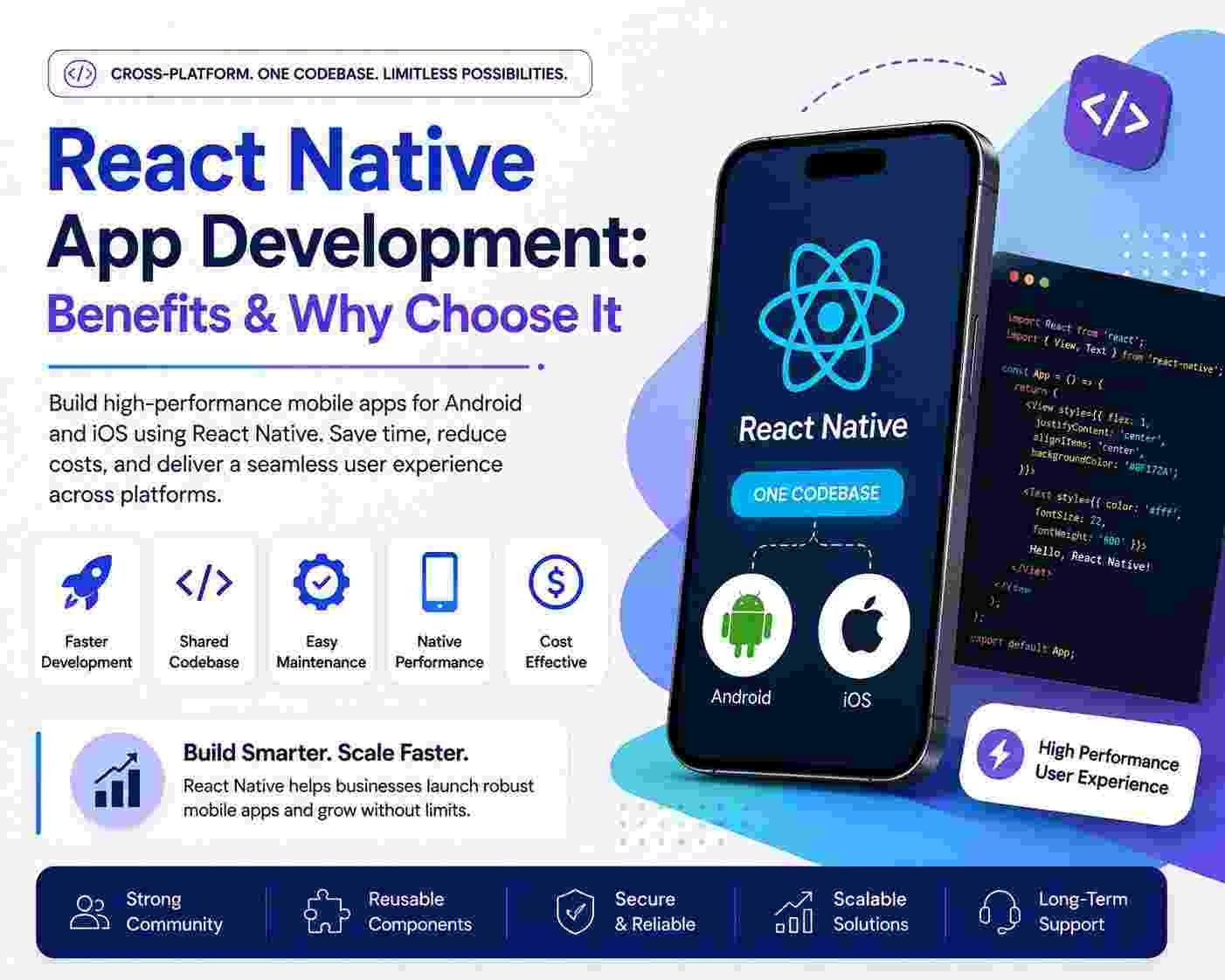
React Native App Development is a cross-platform approach that allows businesses to build mobile applications for Android and iOS using a shared codebase. It can help reduce development effort, support faster product updates, and provide a consistent experience across platforms.
React Native App Development is a practical choice for businesses that want to build mobile applications for Android and iOS while sharing much of the development code. It can help reduce development effort, simplify maintenance, and speed up feature releases. However, the right technology depends on the app's features, performance requirements, integrations, budget, and long-term goals.
React Native supports cross-platform mobile app development.
Businesses can use a shared codebase for Android and iOS applications.
React Native can simplify ongoing maintenance and updates.
It supports integrations with APIs, databases, and native device features.
It is suitable for startups, businesses, and organizations with cross-platform requirements.
Technology selection should depend on the app's actual requirements.
A professional development team can help determine whether React Native fits the project.
React Native App Development is the process of building mobile applications using React Native so that a significant portion of the application code can be shared across Android and iOS platforms.
React Native was introduced by Meta and uses JavaScript and React concepts to create mobile applications.
Instead of maintaining completely separate codebases for every platform, development teams can reuse a substantial amount of application logic while still accessing platform-specific capabilities when required.
This makes React Native particularly useful for businesses looking for cross-platform app development.
Businesses choose React Native for several practical reasons. However, the benefits depend on how the technology is used and the requirements of the application.
One of the biggest advantages of React Native is its cross-platform approach.
A business planning to launch an Android and iOS application can share a substantial portion of the development work between the two platforms.
This can make development and maintenance more manageable than maintaining completely separate applications.
For example:
One product idea → Shared development → Android + iOS
The exact amount of reusable code depends on the application's features and architecture.
React Native can help development teams move faster because developers can reuse code and established components across platforms.
This can be especially useful for businesses that want to:
Launch an MVP
Test a new app idea
Release features quickly
Maintain Android and iOS applications
Iterate based on user feedback
However, faster development should not mean skipping testing or planning.
A well-structured application still requires proper architecture, testing, security, and performance optimization.
Maintaining two completely separate mobile applications can increase development effort.
With React Native, teams can often update shared application logic in one codebase and then deploy changes to both platforms.
This can simplify:
Bug fixes
Feature updates
UI improvements
Business logic changes
Regular maintenance
Platform-specific code may still be required when an application uses native capabilities.
React Native is not limited to basic mobile interfaces.
Applications can interact with device capabilities and native functionality through appropriate libraries and native modules.
Depending on the project, this can include:
Camera
Location
Push notifications
Bluetooth
File storage
Payments
Biometric authentication
Device sensors
The exact implementation depends on the application's requirements and the libraries being used.
React Native allows businesses to build around a shared technology stack instead of creating entirely separate development processes for Android and iOS.
This can make collaboration easier when a development team already has experience with React and JavaScript-based technologies.
It can also help businesses maintain a more consistent product experience across platforms.
React Native can be used for many types of mobile applications.
Examples include:
Companies can build internal or customer-facing apps for:
Employee management
Customer portals
Service bookings
Business dashboards
Communication
React Native can support shopping applications with features such as:
Product catalogs
Search
Shopping carts
User accounts
Payments
Order tracking
Businesses can develop apps for:
Appointment booking
Home services
Delivery
Transportation
Professional services
React Native can also be used for:
Learning platforms
Course applications
Student dashboards
Online assessments
Educational content
Applications requiring dashboards, authentication, payments, and API integrations can also be developed with React Native, provided the architecture and security requirements are properly planned.
The features depend on the purpose of the application.
A typical React Native application may include:
User registration and login
User profiles
Push notifications
Search and filters
Payment integration
Maps and location
Booking systems
Chat functionality
API integration
Admin dashboards
Analytics
Social login
More complex applications may require custom backend systems, databases, third-party APIs, or native modules.
Therefore, the development team should define the feature requirements before selecting the final architecture.
Yes, React Native can be a strong option for many business applications that need Android and iOS support.
It can be especially useful when businesses want:
Cross-platform development
Faster feature delivery
Shared development effort
Consistent application experiences
Easier maintenance
Integration with existing business systems
However, businesses should evaluate the app's performance requirements and technical complexity before making a final decision.
React Native can be a good fit when:
You need both Android and iOS applications.
You want to share development work across platforms.
Your app requires standard mobile functionality and integrations.
You want to launch and iterate relatively quickly.
You expect to maintain the application over time.
Your development team has React or JavaScript experience.
It may require additional technical planning when an application depends heavily on specialized native functionality or highly platform-specific performance requirements.
There is no universal winner.
The right option depends on the application's requirements, expected scale, performance needs, integrations, and development resources.
A typical development process includes several stages.
The team first understands:
Business objectives
Target users
Required platforms
Features
Integrations
Security requirements
Expected scale
The interface and user journey are planned before development begins.
This includes:
Wireframes
User flows
Screen designs
Navigation
Interactive elements
Developers build the application using React Native and the technologies required by the project.
Backend services, APIs, databases, authentication, and third-party integrations can be connected during this stage.
The application should be tested across relevant devices and operating-system versions.
Testing can include:
Functionality
Performance
Responsiveness
Security
API integration
User experience
After testing and final improvements, the application can be prepared for release on the relevant app stores.
After launch, the application may require:
Bug fixes
Security updates
Feature improvements
Performance optimization
OS compatibility updates
Mobile applications should be treated as ongoing products rather than one-time development projects.
There is no fixed cost for React Native app development.
The total investment depends on factors such as:
For this reason, businesses should define the project scope before comparing development estimates.
Choosing the right development partner can affect both the development process and the long-term performance of your application.
Before selecting a Mobile App Development Company in India, consider:
Relevant app development experience
Previous projects
React Native expertise
UI/UX capabilities
Backend development experience
API integration skills
Testing process
Security practices
Post-launch support
Communication process
Don't evaluate companies only by their quoted price.
A lower initial estimate may not include important requirements such as testing, backend development, maintenance, or future updates.
Businesses looking for local technical support can also work with a Mobile App Development Company in Dehradun for React Native app development.
A local development team can be useful when businesses prefer direct communication, project discussions, and ongoing support.
However, location should not be the only selection factor. Evaluate the company's technical expertise, portfolio, communication, development process, and ability to support the project after launch.
React Native can be a practical choice when a business needs applications for both Android and iOS and wants to share development work between platforms.
Its biggest advantages include:
Cross-platform development
Code reuse
Faster iteration
Easier maintenance
Access to native capabilities
Support for modern business applications
However, technology should always follow the project requirements.
A simple app, a complex enterprise platform, and a highly specialized application may require different technical approaches.
Tulyarth DigiWeb provides mobile app development along with web development, web designing, web application development, and digital marketing services.
If you are planning a React Native application, the development process should begin with understanding your business objectives, target users, required features, integrations, and long-term plans.
You can learn more about the company through the About Company page or discuss your project through the Contact Us page.
React Native App Development can help businesses build Android and iOS applications through a cross-platform development approach. It offers code reuse, development efficiency, easier maintenance, and access to native capabilities.
However, the technology should be selected based on the actual needs of the application.
Before starting development, define your target users, core features, integrations, performance requirements, security needs, and long-term goals. Then choose a development approach that can support those requirements.
For businesses evaluating mobile app development options in India or Dehradun, React Native can be a practical choice when cross-platform development and efficient long-term maintenance are important.