How to Monetize a Mobile App: 10 App Revenue Models
- Home
- How to Monetize a Mobile App: 10 App Revenue Models

Published: August 13, 2026
Last Updated: August 13, 2026
If you want to know how to monetize a Mobile App, apart from the simplest option of selling your product on a paid basis, there are several monetization strategies. You can benefit from subscriptions, in-app purchases, advertising, paid downloads, and revenue-based sales of your app, as well as profit from various types of partnerships, such as affiliate marketing, sponsorship, and many other ways. The best monetization method depends on your audience, app functionality, user behavior, and the value your app provides.
For instance, with a product related to the fitness sphere, you can easily build a subscription-based payment system. At the same time, an application focused on the marketplace can generate profits from transaction fees. Hence, for creating the most attractive offer, it is essential to choose the necessary concept before developing the product and studying the audience and its needs.
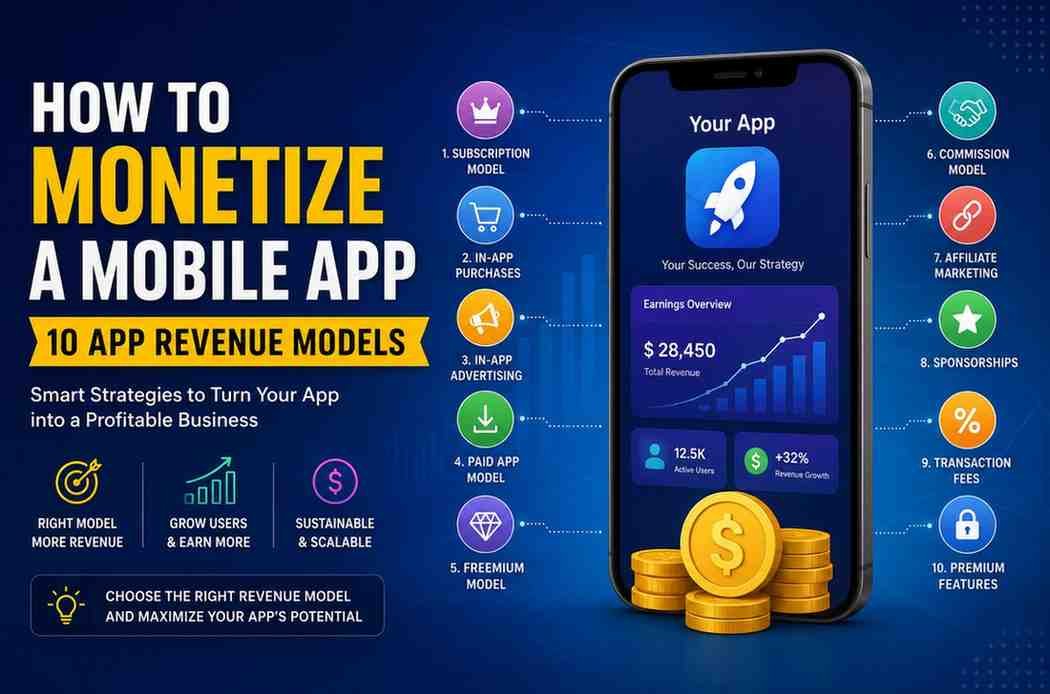
How to Monetize a Mobile App by choosing a revenue model that matches your app, audience, and business goals. The most common app monetization models are subscriptions, in-app purchases, advertising, paid apps, freemium plans, commissions, affiliate marketing, sponsorships, transaction fees, and premium features. The right model depends on how users interact with your app and the value your app provides.
There is no single best app monetization model for every business.
Subscriptions work well when an app provides continuing value.
Advertising can work when an app has a large and engaged audience.
Freemium models let users try basic features before paying.
Marketplaces can earn through commissions or transaction fees.
Your monetization strategy should be planned before app development.
A good revenue model should not damage the user experience.
Mobile apps make money by charging users, businesses, advertisers, or transaction partners for access to products, features, services, or audiences.
The most common mobile app revenue models include:
Subscription
In-app purchases
Advertising
Paid downloads
Freemium
Commission
Affiliate marketing
Sponsorship
Transaction fees
Premium features
However, many successful apps combine two or more models. RevenueCat's 2025 subscription app data, for example, found that more than 35% of apps in its dataset combined subscriptions with consumables or lifetime purchases.
A subscription model charges users repeatedly, usually monthly or annually.
It can work well for:
Fitness apps
Education apps
Productivity tools
Streaming platforms
Business software
Premium content apps
The advantage is predictable recurring revenue when users continue to see value.
However, subscriptions should provide ongoing value. Google Play's current policies require subscription offers to clearly communicate pricing, billing frequency, renewal terms, and other important conditions.
Apple also provides tools for auto-renewing subscriptions and subscription analytics.
Best for
Apps that regularly provide new content, features, services, or benefits.
In-app purchases allow users to buy additional products or features inside your application.
Examples include:
Extra game items
Premium content
Virtual products
Additional storage
Advanced features
Google Play supports in-app purchases for eligible digital products and services through its billing system, subject to its current payments policies.
Apple also supports different types of in-app purchases, including consumable products, non-consumable products, and subscriptions.
Best for
Gaming, education, entertainment, productivity, and content-based apps.
Advertising allows you to offer your application for free while earning revenue from advertisements.
Common formats include:
Banner ads
Interstitial ads
Rewarded ads
Native ads
Video ads
This model can work well when an app has a large number of active users.
However, too many advertisements can frustrate users and increase abandonment. Therefore, ads should be placed carefully without interfering with important app functions.
Google Play also has specific advertising and monetization policies, including additional requirements for apps targeting children.
Best for
Free apps with strong user engagement and frequent usage.
A paid app requires users to pay before downloading or accessing it.
This approach is simple. However, users may be less willing to install an unfamiliar application without trying it first.
Therefore, this model works better when the app has a clear value proposition, strong reputation, or specialized functionality.
Best for
Professional tools, specialized applications, premium utilities, and niche products.
Freemium combines free access with paid upgrades.
Users can download and use the basic version. However, advanced features remain available only to paying customers.
For example, a productivity app might provide basic task management for free while offering advanced reporting, automation, or collaboration features through a premium plan.
Best for
Apps that need a large user base but also have valuable advanced features.
A commission model is useful when your app connects buyers and sellers.
For example, a marketplace app can take a percentage from completed transactions.
This model can work for:
Food delivery
Service marketplaces
Booking platforms
Freelance platforms
E-commerce marketplaces
The app does not necessarily need to charge users a fixed subscription. Instead, revenue grows as successful transactions increase.
Best for
Marketplace and booking applications.
Affiliate marketing allows an app to earn a commission when users purchase products or services through tracked recommendations.
For example, a travel application could recommend hotels, flights, or travel products and earn a commission when users complete qualifying purchases.
The key is relevance.
If recommendations do not match the user's needs, they can reduce trust.
Best for
Shopping, travel, finance, lifestyle, and comparison apps.
Businesses can pay to promote their products or services inside your application.
For example, a fitness app could partner with a sportswear company. Similarly, an education application could work with relevant course providers.
Sponsorships can generate meaningful revenue without charging every user.
However, sponsored content should be clearly presented so users understand its commercial nature.
Best for
Apps with a clearly defined audience and strong engagement.
Some apps make money by charging a small fee whenever users complete a transaction.
This is different from a marketplace commission because the fee can be structured around the transaction itself.
For example, a financial or booking platform may charge a processing or service fee where permitted.
The model works best when the app makes the transaction easier or more valuable for users.
Best for
Booking, financial, service, and commerce applications.
Instead of charging for the complete application, you can offer specific premium features.
For example:
Free version:
Basic tools and limited usage.
Premium version:
Advanced tools, unlimited usage, reports, automation, or additional customization.
This approach gives users an opportunity to understand the app before paying.
It can also work alongside subscriptions or a freemium model.
Best for
Productivity, business, education, design, and utility applications.
There is no universal answer.
The best app monetization strategy depends on your users and the value they receive.
For instance, a business productivity app may generate better long-term revenue through subscriptions than advertisements because its users are paying for functionality rather than consuming free content.
Free apps can make money through several methods.
The most common are:
Advertising
Freemium upgrades
Subscriptions
In-app purchases
Affiliate commissions
Sponsorships
Transaction fees
Therefore, "free" does not mean an app has no business model.
The important question is how the app converts its user base into sustainable revenue without damaging the experience.
Before selecting a model, ask these questions:
Understand whether your audience consists of consumers, businesses, students, professionals, gamers, or another group.
A recurring service may suit subscriptions. A one-time utility may work better with a paid or premium model.
Frequent usage can make advertising or subscriptions more practical.
Study similar applications and understand how they charge users.
Avoid placing revenue ahead of usability.
A good model should support your business without making the application frustrating to use.
Your revenue strategy can affect the way your app is designed.
For example, if you want to offer subscriptions, your application may need:
Account management
Subscription screens
Payment integration
Renewal handling
Feature restrictions
Customer support
Analytics
Similarly, an app using advertising may require ad placement decisions during the UI and UX planning stage.
Therefore, discussing monetization before development can reduce expensive changes later.
If you need help turning your app idea into a functional product, a Mobile App Development Company in India can help you plan the technology, user experience, backend, payment integration, and monetization features together.
Google Play charges service fees on certain transactions involving paid apps and digital purchases. The exact fee depends on the transaction, program, market, and applicable Google Play policies.
Google states that 99% of developers who are subject to a service fee qualify for a fee of 15% or less under its programs. Its current fee structure also includes market-specific changes, so developers should check the latest official documentation before calculating revenue.
This matters when estimating your mobile app revenue, because gross sales and the amount your business ultimately receives are not necessarily the same.
Choosing a revenue model is only the first step. Your application also needs reliable development, UI and UX design, backend integration, payment functionality, testing, analytics, and ongoing improvements.
Tulyarth DigiWeb can help businesses plan and develop applications based on their business goals and target users.
You can learn more about the company on the About Us page.
If you have an app idea and want to discuss development, monetization, or technical requirements, you can Contact Us.
How to monetize a mobile app is not a question with a universal response. The way you make money from the software depends on your user base, engagement rate, and the product’s value proposition.
Subscriptions, in-app purchases, advertising, freemium options, commissions, affiliate marketing, sponsorships, transaction fees, and premium features are all viable ways to generate revenue from a mobile app. However, the right combination depends on your app type, target audience, user behavior, and business goals. Some apps may benefit from combining multiple revenue streams, while others may perform better with a single focused model. Therefore, research your audience, analyze competitors, set clear revenue goals, and choose the monetization strategy that best fits your product.
If you are launching a new application, you may want to turn to professional App Development Services in India to integrate the necessary features and functions and consult about the best monetization strategy for your app.