Custom Website Development: Benefits, Process & Why Businesses Need It
- Home
- Custom Website Development: Benefits, Process & Why Businesses Need It
Published: August 17, 2026
Last Updated: August 17, 2026
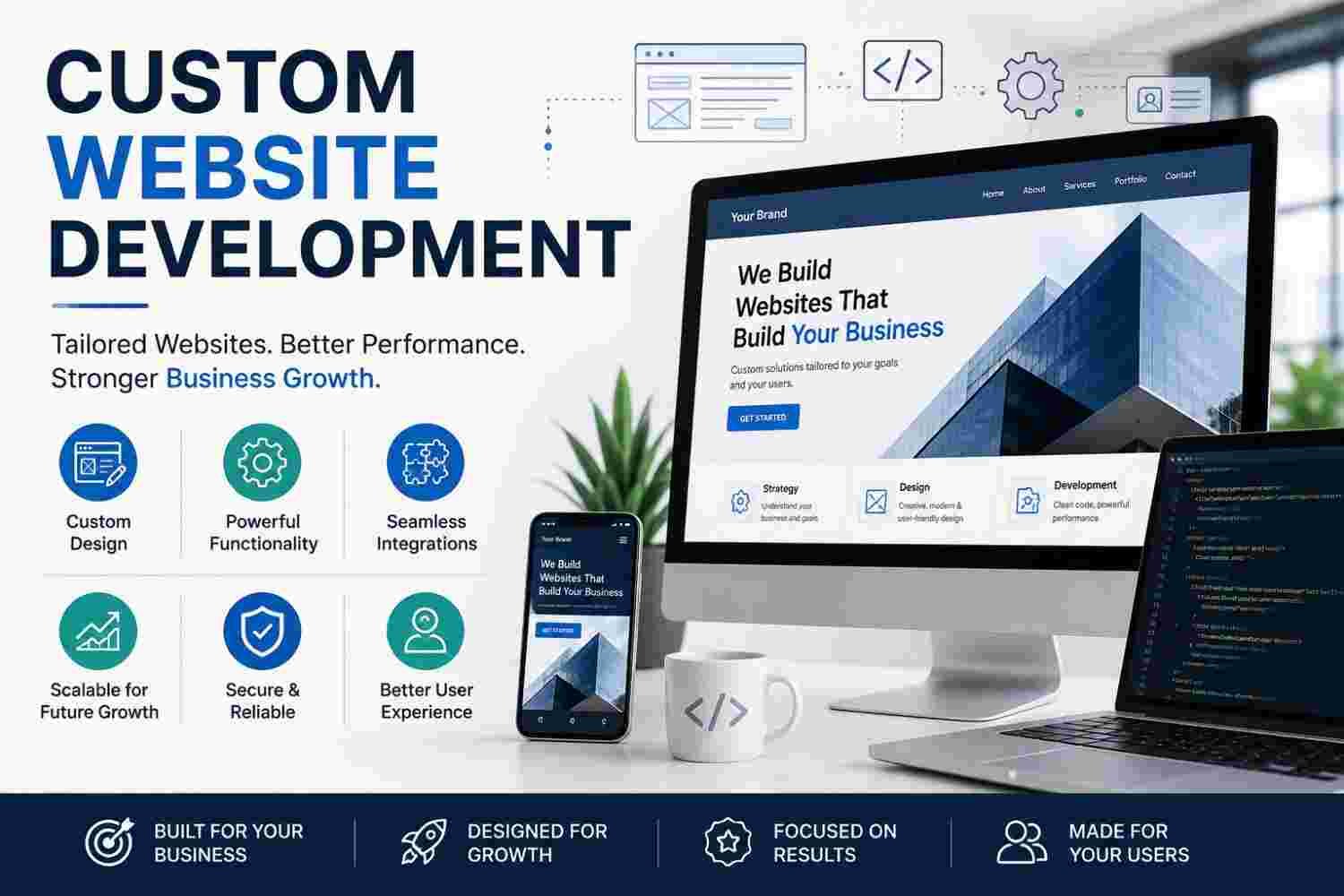
Quick Answer: Custom website development is the process of creating a website specifically around a business's goals, users, branding, features, and workflows instead of relying entirely on a pre-built template. It can give businesses greater control over functionality, scalability, integrations, performance, and user experience.
For a small business with simple requirements, a ready-made platform may be sufficient. However, businesses with unique workflows, advanced features, integrations, or long-term growth plans may benefit more from a custom approach.
Custom websites are designed around specific business requirements.
They provide greater control over features, design, and functionality.
Custom development can support integrations and complex workflows.
A custom website can be expanded as the business grows.
It may require more planning and investment than a basic template website.
The right choice depends on your goals, budget, users, and technical requirements.
Custom website development is the process of designing and developing a website specifically for a business's requirements, rather than building it entirely from a pre-designed template.
The development process can include custom UI/UX design, frontend development, backend functionality, databases, APIs, third-party integrations, security features, and business-specific workflows.
For example, a company may need a website connected to its CRM, payment gateway, inventory system, customer dashboard, or internal software. A custom solution can be designed around those requirements from the beginning.
Google recommends creating helpful, reliable, people-first content and making pages useful compared with other results. The same principle applies to websites themselves: the experience should serve the user's needs rather than simply adding features for the sake of technology.
Businesses usually choose custom development when standard website solutions cannot provide the required functionality or flexibility.
Here are some of the main benefits.
A custom website allows the design to reflect your brand rather than forcing your business into a fixed template.
You can control:
Page layouts
Brand colors
Typography
Navigation
Interactive elements
User journeys
Calls to action
As a result, the website can provide a more consistent experience across important pages.
One of the biggest advantages of custom web development is control.
Instead of adapting your business process to an existing template, developers can build functionality around your actual requirements.
For example, a business may need:
Customer dashboards
Appointment booking
Custom forms
Membership systems
Product configurators
User accounts
Payment integrations
Admin dashboards
The website can be developed around these specific requirements.
Modern businesses often use several digital platforms.
A website may need to communicate with:
CRM software
Payment gateways
Email marketing platforms
ERP systems
Accounting software
Inventory systems
APIs
Analytics platforms
Custom development can make these integrations part of the website architecture instead of treating them as an afterthought.
A website that works for 100 customers may need a different architecture when the business has thousands of customers.
Custom development allows the technical structure to be planned with future requirements in mind.
That does not mean every website needs an advanced architecture from day one. Instead, the development team should understand where the business is heading and build an appropriate foundation.
Your users may follow a specific journey before making a purchase, booking a service, submitting an inquiry, or creating an account.
Custom development allows that journey to be designed around your audience.
For instance:
Landing page → Product selection → Custom form → Payment → Confirmation
A custom workflow can reduce unnecessary steps and make important actions easier to complete.
The features depend on the business model.
A basic business website might need:
Responsive design
Contact forms
Service pages
Lead-generation forms
Blog functionality
Social media integration
Analytics
Basic security
A more advanced platform might require:
Customer login
User dashboards
Online payments
Booking systems
API integrations
Custom databases
Role-based access
Automated notifications
Advanced search
Admin management panels
Therefore, there is no universal feature list for custom websites. The right features should be selected according to business objectives and user needs.
A professional development process generally involves several stages.
First, the development team understands the business, audience, goals, competitors, required features, and technical requirements.
This stage helps prevent unnecessary development work later.
Next, the team plans the website structure, technology, database requirements, integrations, content structure, and user journeys.
At this point, businesses can also identify which features are essential for launch and which can be introduced later.
The design stage focuses on how the website looks and how users interact with it.
Wireframes and interface designs can help establish the structure before development begins.
Developers then build the frontend and backend functionality.
Depending on the project, this may involve custom code, databases, APIs, content management systems, payment systems, or other technologies.
Before launch, the website should be tested across relevant devices and browsers.
Testing can cover:
Forms
Links
Navigation
Responsiveness
Functionality
Security
Performance
Integrations
After testing, the website can be deployed.
However, development should not necessarily end at launch. Businesses may need ongoing updates, security improvements, content changes, performance monitoring, and new functionality.
Tulyarth DigiWeb also provides website development and related digital services, including web development, web designing, web application development, and mobile app development.
There is no single fixed price for custom website development because the cost depends on the project's requirements.
Important factors include:
The biggest mistake is choosing a development budget based only on the number of pages.
A 10-page website with complex functionality can require considerably more development work than a larger website containing mostly standard informational pages.
Tulyarth DigiWeb already has a detailed guide on Website Development Cost in India, covering pricing, website types, development factors, and hidden costs.
Is Custom Website Development Right for Every Business?
No.
A custom website is not automatically the best choice for every business.
A simple website with a few pages, basic contact information, and standard functionality may not need extensive custom development.
However, custom development can make more sense when a business needs:
Unique functionality
Complex workflows
Custom integrations
Advanced user accounts
Scalable architecture
Specialized dashboards
Greater control over the user experience
The decision should therefore be based on requirements rather than the assumption that custom development is always better.
The right option depends on the business.
A company with a unique business model may benefit from custom development, while a new business with simple requirements may prefer a faster and simpler solution.
Before selecting a Website Development Company in India, evaluate more than price.
Look at:
Previous projects and portfolio
Relevant technical experience
Understanding of your industry
Development process
Communication and support
Security and performance approach
Maintenance options
Ability to handle future requirements
Also, ask what is actually included in the development package.
A clear scope can prevent misunderstandings about design revisions, integrations, hosting, maintenance, and future changes.
For businesses specifically looking for Custom Website Development in India, choosing a team that understands both technical requirements and business objectives can make the development process more effective.
Although businesses across India can use custom development, local businesses in Dehradun can also benefit when they need websites designed around specific services, booking processes, lead generation, or customer workflows.
For example, a local service business may require:
Service pages → Location targeting → Inquiry form → Lead management → Follow-up
A more complex company may require a customer portal, CRM integration, payment functionality, or a custom dashboard.
Therefore, the development approach should be based on the business rather than simply its location.
Tulyarth DigiWeb works across web development, web designing, web applications, mobile apps, and digital marketing. Its website also lists customized software among its offerings.
If you want to understand the company and its approach, visit the About Company page.
For a project discussion, you can also use the Contact Us page. The company's current contact page lists web development, web designing, web application development, mobile app development, and digital marketing among its services.
Conclusion
Custom Website Development can give businesses greater control over design, functionality, integrations, and future growth. However, the right solution depends on what the business actually needs.
Before starting development, define your goals, identify essential features, understand your users, plan integrations, and set a realistic budget. Most importantly, choose technology based on business requirements rather than adding features simply because they are available.
A well-planned custom website should not only look professional. It should also make it easier for users to find information, take action, and interact with the business.