How to Improve Website Speed for Better Google Rankings
- Home
- How to Improve Website Speed for Better Google Rankings


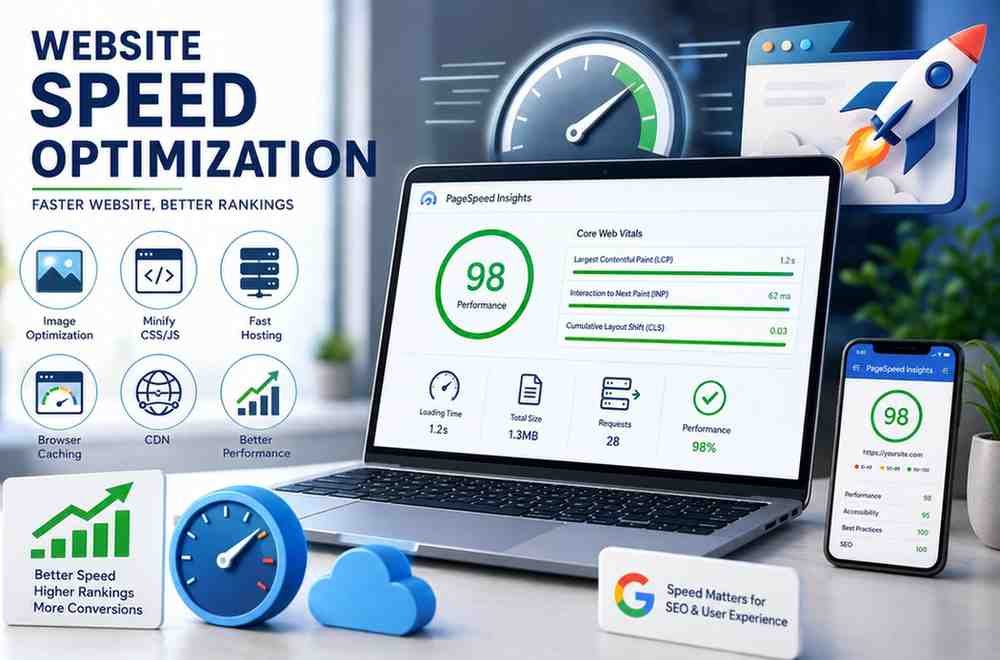
Your website may be filled with high-quality content and a beautiful design, but if it takes a lot of time to load, then you will have a poor chance to retain your visitors. Website Speed Optimization is one of the most crucial aspects of modern online marketing. It directly affects the conversion rate and determines the website’s position in search engine results. A professional website speed optimization service helps to increase the performance of your web resource, provides a better user experience, and allows search engines to index your website faster. In this article, you will learn how to Improve Website Speed, why is it so important for SEO, and which optimization methods you should use to make your website blazing fast.
Website Speed Optimization refers to the entire set of measures aimed at increasing the speed of website loading. This can be achieved through image optimization, minimizing the use of resource-heavy code, browser caching, and other methods. In terms of website performance, everything is relative; therefore, it is critical to optimize your site to gather more traffic and keep it engaged. Having a fast website will not push your page higher in Google, but its speed will impact the rankings substantially.
Yes, because Google officially states that page speed affects overall page experience. Fast websites are often able to deliver a better experience to the users, decreasing bounce rate and increasing engagement.
Website speed is just one of the ranking factors, but by investing in the Website Speed Optimization plus quality content creation and SEO, you will maximize your chances of getting high in the search engine results.
If you are looking to improve your Google ranking, speed up your website! Not only is it good for SEO, but it also helps conversions, creates a better experience for the users, and boosts credibility. For most companies, it is one of the best ROI investments in digital marketing.
Google strives to provide its users with relevant and high-quality resources. At the same time, ensuring their safety and comfort is also important. Hence, the optimization of page speed became a part of Google's quality standards.
Every surfer who lands on your website expects it to be nice and quick. However, if it fails to meet their expectations, they will not wait for it to load. This will result in a high bounce rate, a low level of engagement, and missed conversions.
Website Speed for SEO is extremely important nowadays because of the growing need for rapid page loading. It not only provides a pleasant experience for surfers but also positively impacts the crawling process.
A properly optimized website can also improve:
Organic search visibility
User engagement
Average session duration
Lead generation
Conversion rates
Customer satisfaction
For businesses that depend on online enquiries or ecommerce sales, website speed directly affects revenue.
Although content quality remains Google's highest priority, speed plays an important supporting role.
Google introduced Core Web Vitals to measure how users experience a webpage. These metrics evaluate loading speed, responsiveness, and visual stability.
The three primary Core Web Vitals are:
Measures how quickly the main content becomes visible.
Measures how quickly the website responds to user interactions.
Measures whether page elements move unexpectedly while loading.
Improving these metrics helps both users and search engines.
Several industry studies highlight the importance of website performance.
According to Google Search Central, page experience contributes to how Google evaluates webpages alongside many other ranking signals.
Research from Google has shown that as page load time increases, the probability of users leaving the page also rises significantly.
Statista reports that internet usage continues to grow worldwide, making website performance increasingly important as more users browse on mobile devices.
Studies consistently show that faster websites generally achieve better engagement and higher conversion rates than slower websites.
These statistics demonstrate why businesses should treat speed as an ongoing priority rather than a one-time improvement.
As you can see, improving website speed benefits both your visitors and your business.
There is no single solution that instantly makes every website fast. Instead, Website Speed Optimization combines several technical improvements that work together.
Some of the most effective methods include:
Compressing and resizing images
Enabling browser caching
Reducing unnecessary CSS and JavaScript
Using modern image formats
Choosing faster web hosting
Optimizing Core Web Vitals
Removing unused plugins
Using a Content Delivery Network
Improving server response time
Businesses that regularly monitor website performance usually experience more stable rankings and a better user experience over time.
If you want to Improve Website Speed, you need to focus on the factors that have the biggest impact on loading time. Many website owners install several optimization plugins but ignore the real issues affecting performance.
A successful Google PageSpeed Optimization strategy combines technical improvements, better hosting, optimized code, and regular maintenance.
Below are the most effective techniques.
Large images are one of the biggest reasons websites become slow.
Instead of uploading high-resolution images directly from your phone or camera, resize and compress them before adding them to your website.
You should also use modern image formats like WebP, which provide excellent quality while reducing file size.
Compress every image before uploading.
Use WebP whenever possible.
Resize images according to the page layout.
Enable lazy loading for images below the first screen.
Smaller images improve loading speed without reducing visual quality.
Even if your website is perfectly optimized, poor hosting can still slow it down.
Reliable hosting improves server response time, uptime, and overall website performance.
If your website receives increasing traffic, upgrading to a better hosting plan can significantly improve speed.
Many businesses invest in Website Development Services but continue using low-quality hosting, which limits performance.
Browser caching allows visitors' browsers to store website files locally.
When users return to your website, many files load from their device instead of downloading again from the server.
Benefits include:
Faster loading for returning visitors
Reduced server load
Better browsing experience
Browser caching is one of the simplest improvements with long-term benefits.
Every website contains CSS, JavaScript, and HTML files.
Over time, these files often include unnecessary spaces, comments, and unused code.
Minification removes unnecessary data without affecting functionality.
Benefits include:
Smaller file sizes
Faster downloads
Better website performance
For WordPress websites, several optimization plugins can automate this process.
A Content Delivery Network (CDN) stores copies of your website on multiple servers around the world.
Instead of loading your website from one location, visitors receive content from the nearest server.
Benefits include:
Faster global loading
Reduced server load
Improved website reliability
Better international performance
CDNs are especially valuable for ecommerce websites and businesses serving customers across different cities or countries.
Installing too many plugins slows down your website.
Every plugin adds extra code, scripts, database queries, or external requests.
Review your plugins regularly and remove those you no longer use.
A smaller, cleaner website performs much better.
As your website grows, the database stores revisions, spam comments, temporary files, and unused information.
Cleaning the database regularly improves website performance.
Database optimization should become part of your regular Website Maintenance Services rather than a one-time task.
Google evaluates websites using Core Web Vitals.
Focus on improving:
Largest Contentful Paint
Interaction to Next Paint
Cumulative Layout Shift
Improving these metrics creates a better user experience while strengthening Website Speed for SEO.
Before publishing or updating your website, review this checklist.
Compress images
Use WebP images
Enable browser caching
Minify CSS and JavaScript
Remove unused plugins
Upgrade hosting if required
Optimize the database
Use a CDN
Test website speed regularly
Monitor Core Web Vitals
Following this checklist consistently helps maintain excellent website performance.
Although many website speed improvements can be handled using plugins, the biggest performance gains usually come from proper development.
A trusted Website Development Company in India builds websites with clean code, responsive layouts, optimized images, and scalable architecture from the beginning. This reduces future maintenance while improving loading speed.
Businesses that invest in Custom Website Development in India often achieve better long-term performance because every feature is built according to business requirements rather than relying on unnecessary templates or excessive plugins.
Similarly, a Professional Website Design Company in India focuses on both design and performance. A visually attractive website should also load quickly and work smoothly across all devices.
Website speed is not only a development issue. It is also an important part of Technical SEO Services.
Technical SEO ensures that search engines can crawl, understand, and index your website efficiently.
A complete technical SEO audit usually includes:
Core Web Vitals analysis
Broken link detection
Crawl error identification
Image optimization
Mobile usability testing
Structured data validation
Page speed improvements
When combined with professional SEO Services in India, these optimizations help improve both search visibility and user experience.
Improving the speed of your website should not revolve around what test tools say and how you can beat a certain score. Instead, it should be about providing a better experience to your users.
From our experience, we have noticed that companies that care about monitoring and improving their score and have updated their websites have much better engagement and SEO results than those who only focus on optimizing for speed.
A lot of website owners overlook the importance of website speed. They assume that it only plays a role in SEO, but it also influences other aspects of the customer journey. For example, a fast website creates a good first impression and encourages exploration – leading to higher engagement and conversion rates.
If your website is optimised and loads quickly, then your customers will be more inclined to fill out a contact request or make a purchase. They will also spend more time on your website browsing through your products or services rather than waiting for it to load. This results in an increase in enquiries and overall customer satisfaction.
Therefore, website speed should be prioritised as an ongoing business initiative.
Website speed is not the lone aspect of a successful online strategy. To be able to accomplish growth in business, you need to ensure that your website has got quality content, technical SEO, and a strong digital marketing plan.
A reliable Digital Marketing Company in India can work on Website Speed Optimization, SEO, content marketing, and enhancement of performance to meet your expectations and help drive traffic to your website while converting them into customers.
On the contrary, companies that invest in the Website Maintenance Services can detect the speed problems and help maintain security and performance to assist your site’s smooth performance in line with technological developments.
At Tulyarth DigiWeb, we believe a high-performing website should do more than just look good. It should load quickly, rank well on search engines, and provide an excellent user experience across all devices.
Our team provides:
Website Development Services
Website Speed Optimization
Technical SEO Services
Website Maintenance Services
Custom Website Development in India
SEO Services in India
Performance-focused website improvements
Every project is developed with performance, security, scalability, and long-term business growth in mind.
To learn more about our expertise, visit our About Us page.
If you would like us to optimize your website's performance or build a fast, SEO-friendly website, visit our Contact Us page.
A fast website is no longer a luxury, but a necessity. It plays a critical role in providing an enhanced user experience and boosting your online presence.
With our Website Speed Optimization service, you can enjoy faster loading times, improved SEO performance, reduced bounce rates, and an all-round better experience for your website visitors.
Optimization techniques such as image compression, browser caching, excellent hosting, minification, and regular Core Web Vitals checks, among others, can have a significant impact on your website’s speed and, by extension, its success.
While most optimizations can be done by website owners, speed optimization requires expertise and know-how to ensure that sites are fast, secure, and future-proof.
Whether you want to improve your search ranking or simply provide a better experience to your customers, a faster website should always be a priority.
Continue learning with these helpful guides: