
How Long Does SEO Take to Show Results in Google? A Realistic Timeline
- Home
- How Long Does SEO Take to Show Results in Google? A Realistic Timeline
Published: September 12, 2026
Last Updated: September 12, 2026
How Long Does SEO Take to Show Results? In many cases, businesses may start seeing meaningful SEO progress within 3 to 6 months, while competitive industries and newer websites can take longer. There is no fixed timeline because results depend on the website's authority, competition, technical health, content quality, links, search intent, and how consistently SEO work is implemented.
However, SEO does not suddenly “switch on” after three months. Early signs can appear much sooner. Google says some website changes can take hours, while others may take months to produce noticeable effects. It recommends waiting a few weeks before assessing whether changes are having an impact.
So, instead of asking only “When will I rank #1?”, it is better to ask:
“What progress should I expect at each stage of SEO?”
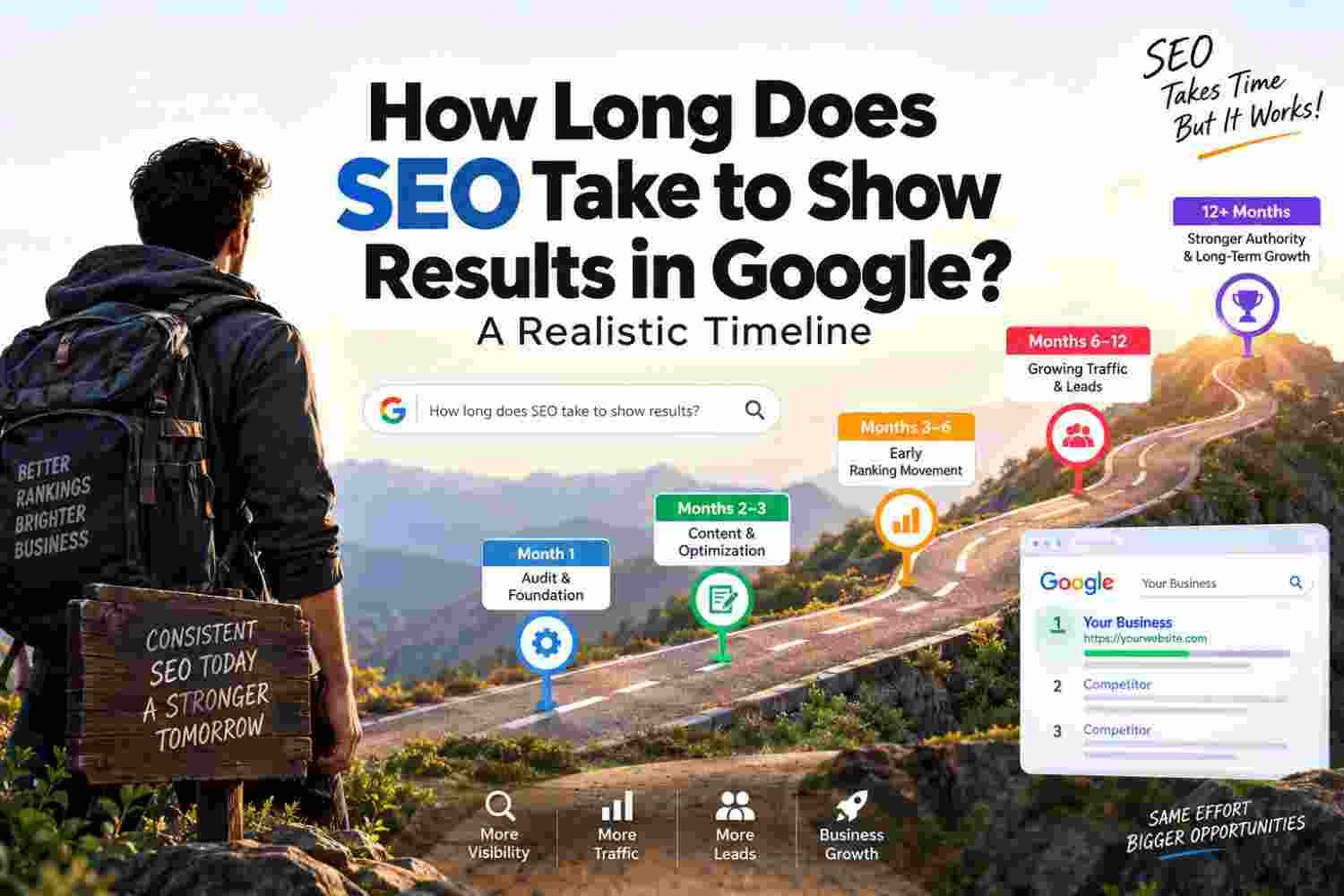
SEO is a long-term process rather than a one-time marketing activity. A realistic SEO ranking timeline often looks like this:
These are guidelines, not guarantees. Some pages can move faster, especially when competition is low, and a website already has authority. Others may require much more time.
SEO results usually build gradually instead of appearing overnight.
3 to 6 months is a commonly cited timeframe for meaningful SEO progress.
New websites generally need more time than established websites.
Competitive keywords can take much longer to reach the first page.
Impressions and ranking improvements can appear before significant traffic increases.
SEO should be measured using multiple metrics, not just one keyword position.
Consistent optimization matters more than publishing content randomly.
There is no universal answer.
For many businesses, 3 to 6 months is a practical timeframe for measuring meaningful progress. However, some websites see earlier movement, while highly competitive websites may need 6 to 12 months or longer to build substantial visibility. Ahrefs' research also places the typical timeframe around three to six months.
Google itself does not promise a specific ranking timeline. Its documentation explains that changes can take from a few hours to several months to be reflected in Search, and not every change produces a noticeable ranking improvement.
Therefore, any agency promising “guaranteed #1 rankings in 30 days” should be treated carefully.
The first month is often about fixing the foundation.
An SEO campaign may begin with:
Website and technical audits
Keyword research
Search intent analysis
Competitor research
Metadata improvements
Internal linking
Indexing checks
Website structure improvements
Content planning
At this stage, traffic may not change dramatically. However, important groundwork is being completed.
Google needs to crawl, process, and understand website changes before they can influence search visibility.
Next, the SEO strategy starts becoming visible across the website.
This can include:
Publishing or improving content
Updating title tags and headings
Strengthening internal links
Fixing technical SEO problems
Improving service pages
Creating supporting content
Building relevant authority signals
During this stage, some keywords may begin moving upward. Long-tail and lower-competition keywords can sometimes show progress earlier.
However, rankings can also fluctuate. A page moving from position 60 to 38 and then back to 45 does not necessarily mean the strategy failed.
Google is continually reassessing search results.
This is often where SEO begins to produce more measurable signals.
You may notice:
More keywords ranking
Higher impressions
Better average positions
Increased organic clicks
More pages appearing in Search
Early lead generation from organic traffic
Importantly, impressions can rise before clicks rise significantly. A page may begin appearing for more searches while still ranking too low to receive substantial traffic.
That is why Google Search Console is useful for understanding SEO progress beyond a simple ranking report. Google describes Search Console as a tool for understanding how a site performs in Google Search.
With consistent work, SEO can begin producing broader results over time.
A website may gain:
More first-page rankings
Higher organic traffic
Stronger topical relevance
More branded searches
Better commercial keyword visibility
More qualified leads
Still, this stage is not the end of SEO.
Successful websites continue updating content, improving underperforming pages, strengthening authority, and responding to changes in search behavior.
A new website usually needs more patience.
Why?
Because it may have:
Little or no backlink history
Limited content
Minimal search visibility
Few established pages
Low topical authority
No historical performance data
An established website, on the other hand, may already have indexed pages, backlinks, and existing authority. Therefore, new content can sometimes gain visibility faster.
Ahrefs notes that website history and existing authority can significantly affect how quickly SEO results appear.
That does not mean a new website cannot rank. It simply means the foundation often takes longer to build.
Local SEO can sometimes show meaningful progress faster than highly competitive national SEO. However, the timeline still depends on the location, industry, and competition.
For example, a local service business targeting a specific city may have a narrower competitive landscape than a company targeting a broad national keyword.
Local SEO commonly involves:
Google Business Profile optimization
Local landing pages
Location-focused content
Reviews and reputation signals
Consistent business information
Local citations
Relevant links
For businesses competing in a city such as Dehradun, targeting relevant local search intent can be more practical than immediately competing for broad national keywords.
Older websites often have more established content and links. Newer websites may need more time to build authority.
Ranking for a low-competition long-tail keyword is usually easier than competing for a broad, high-volume keyword.
Google emphasizes helpful, reliable, people-first content rather than content created primarily to manipulate rankings.
Crawlability, indexability, site structure, and other technical issues can affect how efficiently search engines understand a website.
A page needs to satisfy what the searcher actually wants.
For example, a user searching “how long does SEO take” is looking for information. A user searching “SEO company in Dehradun” is much closer to taking commercial action.
Strong internal linking helps search engines discover related pages and understand relationships between content.
Relevant links can contribute to a website's authority. However, link building should focus on quality and relevance rather than quantity alone.
SEO requires ongoing work. Publishing one article and then stopping for several months rarely creates a sustainable strategy.
Do not judge your campaign only by asking:
“Am I #1 yet?”
Instead, monitor several indicators.
Google Search Console is particularly useful for monitoring Search performance and identifying opportunities or problems.
Ranking fluctuations are normal.
Google uses automated ranking systems that evaluate huge numbers of pages using multiple signals. Rankings can change as Google processes new information, competitors publish or improve content, and search results are reassessed.
Therefore, one bad day does not automatically mean your SEO strategy is failing.
Instead, look for trends across several weeks or months.
Yes, some movement can happen within 30 days, but that should not be confused with guaranteed meaningful business results.
A website with strong existing authority might see certain pages move relatively quickly. A new website targeting difficult keywords is much less likely to achieve strong rankings in only one month. Search Engine Land's recent SEO timeline also emphasizes that stable, meaningful results usually require more time and that competitive terms can take significantly longer.
So, 30 days should usually be viewed as a foundation and early-signal period, not a deadline for ranking #1.
Focus on sustainable improvements:
Create useful content. Answer real questions clearly and completely.
Target the right keywords. Choose keywords based on intent, competition, and business relevance.
Improve existing pages. Updating an underperforming page can sometimes be more useful than continuously publishing new content.
Fix technical problems. Make it easy for Google to crawl, understand, and index your website.
Build relevant authority. Earn quality links and mentions instead of relying on spammy tactics.
Track performance. Use Google Search Console and other analytics tools to identify what is working.
Google's guidance specifically recommends helpful, reliable, people-first content and warns against creating content mainly to manipulate rankings.
When Should You Change Your SEO Strategy?
Do not change your strategy simply because a keyword has not reached position one after a few weeks.
Instead, investigate:
Is the page indexed?
Is the content matching search intent?
Are competitors providing better answers?
Is the keyword too competitive?
Is the page targeting the right query?
Are impressions increasing?
Are other related keywords improving?
Are technical issues limiting performance?
If a page is receiving impressions but very few clicks, the next opportunity may be improving its ranking position, search intent alignment, title or snippet appeal.
SEO works best as a process of testing, measuring, and improving, rather than making random changes.
So, how long does SEO take to show results in Google?
For many websites, 3 to 6 months is a realistic timeframe for meaningful progress, while newer websites and highly competitive industries may need significantly longer.
However, SEO progress starts before major traffic growth appears.
First, technical foundations improve. Then, pages get optimized. Next, rankings and impressions begin moving. Eventually, stronger visibility can turn into traffic, leads, and business growth.
The key is to measure SEO as a long-term growth process, not as a 30-day ranking promise.
For more information about the company and its digital services, visit about Tulyarth DigiWeb page. When you're ready to discuss an SEO requirement, you can contact Tulyarth DigiWeb about your project.
Business Automation Software: What Can You Automate and Why Does It Matter?
API Integration in Web Development: Benefits, Process & Common Use Cases
Web Application Development in Dehradun: Services, Process & Benefits
Ecommerce Website Development in Dehradun: Complete Guide for Businesses
How to Choose a Digital Marketing Company in Dehradun: Complete Guide