SEO vs GEO vs AEO: What Indian Businesses Need in 2026
- Home
- SEO vs GEO vs AEO: What Indian Businesses Need in 2026
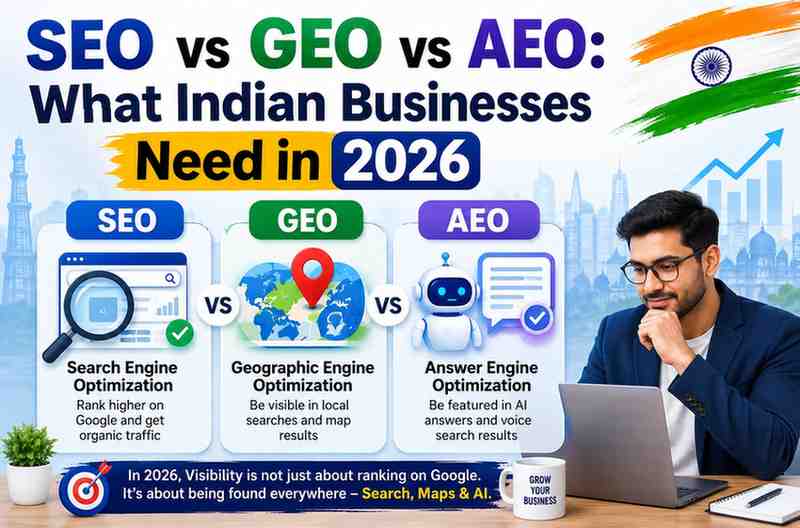
Search is changing quickly, and your business cannot rely on only one kind of visibility anymore. In 2026, you need to understand seo vs geo vs aeo if you want to stay visible in Google search, AI answers, and direct response results. The goal is not just clicks. It is trust, reach, and real business growth.
Many Indian businesses still focus only on search rankings. That helps, but it is no longer enough. People now ask Google, ChatGPT, Gemini, and Perplexity for answers before they visit a website. So, your content needs to work for search engines, answer engines, and generative engines at the same time.
The phrase seo vs geo vs aeo may look technical, but the idea is simple. SEO helps your website rank on search engines. GEO helps your content appear in AI generated answers. AEO helps your content become the direct answer to a question.
If you run a business in India, this matters a lot. Your audience may search on Google, but they may also ask for an AI tool first. That means your content must be clear, useful, and easy to extract. If it is not, you may lose visibility even if your site has good pages.
The best strategy is not to choose one and ignore the others. Instead, you should build content that supports all three. That is how you stay relevant in 2026.
Search Engine Optimization (SEO) It helps your website appear higher in search results when people search for a product, service, or question. Good SEO starts with the right keywords, useful content, clear structure, and strong page performance.
For Indian businesses, SEO still brings major value. People search for local services, software, pricing, comparisons, tax help, education, and business solutions every day. If your page matches that search intent, you can earn steady organic traffic without paying for every visit.
SEO also helps search engines understand your website better. Clear headings, internal links, fast loading pages, and helpful content all support ranking. That is why SEO remains the base of digital growth.
Generative Engine Optimization (GEO) is the process of optimizing content so AI tools like ChatGPT, Gemini, and Perplexity can understand, cite, and recommend it in generated answers.
So, GEO is about making your content easy for AI systems to read, trust, and cite. Your content should be structured, factual, and written in simple language. It should answer the main question directly instead of hiding the answer in a long block of text.
For Indian businesses, GEO is becoming important across many sectors. It matters for software, education, finance, local services, and digital marketing. If your content is clear and specific, it has a better chance of being used in AI answers.
Answer Engine Optimization (AEO) It helps your content become the direct answer to a user’s question. This is useful for featured snippets, voice search, and answer boxes.
AEO works best when you place a short answer near the top of the section. Then, you can expand with more detail below. This format helps both people and search engines understand your content fast.
For example, if someone asks, “What is GEO?” your page should answer in one or two lines first. After that, you can explain the idea in plain language. That style improves clarity and search usefulness.
Here is the simple difference between SEO, GEO, and AEO.
This is why seo vs geo vs aeo should not be treated like a fight between three separate ideas. They support each other. SEO gives you discovery. GEO gives you AI visibility. AEO gives you direct answers.
Indian buyers are using search in a more mixed way now. Some still go to Google first. Others ask AI tools for shortlists, comparisons, and quick explanations. That change makes GEO important for many businesses.
If you are a consultant, agency, software company, or local service provider, GEO can increase your visibility in places where users are already looking for answers. Even when someone does not click immediately, they may still remember your brand name. That can shape later trust and purchase decisions.
GEO also helps when you create content for Indian needs. Local examples, practical details, and simple explanations improve usefulness. When your content feels grounded in a real business context, AI systems are more likely to treat it as helpful.
Google AI Overviews are changing how people read search results. Instead of opening many links, users often read the summary first. That means your content must be easy to understand and easy to pull into an answer.
This is where seo vs geo vs aeo becomes very practical. SEO helps your page reach search results. AEO helps your page answer the query directly. GEO helps your content get used inside AI summaries.
If your page is vague or thin, it may get skipped. But if your content is clear, specific, and genuinely helpful, it has a much better chance of appearing in AI driven search experiences. That is why content quality matters more than ever.
To appear in ChatGPT, Gemini, and Perplexity style answers, your content must be easy to trust and easy to quote. These tools often prefer pages that are structured well and written with clear intent.
Start with headings that match real questions. Then answer those questions in simple language. Keep sentences short. Use direct explanations. Also, give practical examples that fit the Indian market.
You should also build topical depth. One page is rarely enough if the topic matters to your business. Create supporting blogs, FAQs, about pages, and service pages
so your site becomes a reliable source on that topic.
The best GEO strategy starts with clarity. Write for a real person first. If your reader understands the page quickly, AI systems usually do a better job too.
Use these practical steps:
Add direct answers near the top of each section.
Use question based headings where possible.
Keep paragraphs short and focused.
Include Indian examples and business use cases.
Use the same terms across your site.
Add FAQs that reflect real search intent.
Make sure your pages work well on mobile.
You should also strengthen your internal pages. Your Website Development Services page can support technical authority. Your SEO Services page can support search visibility. Your Digital Marketing Services page can support broader discovery.
For businesses that sell software solutions, dedicated service pages matter too. A strong CRM Software page can help explain features clearly. Likewise, an NBFC Software page can support more specific search intent and better topical relevance.
Let us take a software company in Dehradun as a simple example. Suppose it offers CRM and automation tools for small businesses. With SEO, it can rank on Google for searches like “best CRM software for small business in India.” That brings traffic from people actively looking for a solution.
Now add GEO. The company can publish a detailed page that explains features, pricing logic, use cases, and common buyer questions. Because the content is useful and structured, AI tools may cite it when people ask for CRM recommendations or software comparisons.
Then comes AEO. If the same page answers questions like “What is CRM software?” or “Who should use CRM software?” in short, clear lines, it can win featured snippets and direct answer placements. In other words, seo vs geo vs aeo can all work together on one strong page.
That is the real advantage. You are not depending on one channel. You are building visibility in search, in answers, and in AI summaries at the same time.
The best answer is simple. Start with SEO, then add GEO and AEO. SEO gives your website a strong base. GEO expands your reach into AI answers. AEO helps you win quick answers and snippets.
If your business is new, focus first on SEO fundamentals. Build useful pages, improve your site structure, and target the right search intent. After that, refine your content so it can also work for AI and answer engines.
If your business already gets traffic, then GEO and AEO can give you the next level of visibility. They help you stay useful even as search behavior shifts. That is why a combined approach works best in 2026.
Search marketing in 2026 is broader than rankings alone. People want fast answers, trusted sources, and simple explanations. They also want content that feels practical and easy to use.
This means your content strategy must be flexible. Write for search engines, but also write for AI systems and human readers. Focus on clarity, usefulness, and structure. Those three things matter everywhere.
Indian audiences are especially diverse. Some users want simple explanations. Others want comparisons before they buy. So, your content should meet both needs without sounding stiff or repetitive. That is where smart planning makes a real difference.
If you want stronger visibility, add the right schema to your page. Use FAQ Schema, Organization Schema, and Article Schema to help search engines understand your content better. These can also support AEO and AI visibility.
Schema does not replace good content. However, it makes your page easier to interpret. When combined with clear writing and strong structure, it can improve how your content appears in search and answer experiences.
The future of search is no longer only about blue links. It is about being visible in search engines, AI systems, and answer driven results. That is why seo vs geo vs aeo matters so much for Indian businesses in 2026.
If you want better growth, build content that is clear, useful, and easy to trust. Use SEO as your base, GEO for AI visibility, and AEO for direct answers. When these three work together, your content becomes much stronger and much more discoverable.